
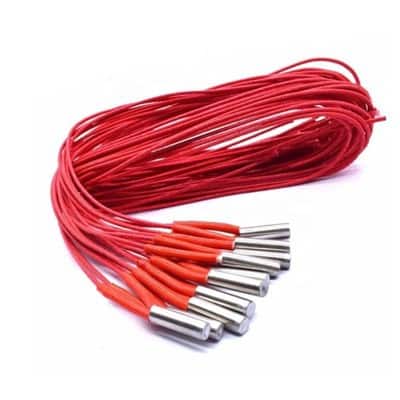
HIGH WATT DENSITY
3d Printer Heater 12v 40w
3d Printer Heater 12v 40w by LICHENGDA. Bore fit and conductive heat transfer, configuration details and made-to-drawing quotation for molds, dies and conductive tooling.
Product image gallery (6)


PRODUCT ENGINEERING
Bore fit and conductive heat transfer
3d Printer Heater 12v 40w: Install the active sheath in a close-fitting, clean bore. Specify bore diameter, tolerance and heated length together; excessive clearance increases sheath temperature and slows heat transfer.
Record the lead exit, cold end and removal access before the tool is machined. Locate the control sensor near the heated zone without placing it directly against the resistance element.
Using the catalog-name values 12 V and 40 W, a single resistive load has an indicative current of 3.33 A and resistance of 3.60 Ω (I = P/V; R = V²/P). These calculations assume one element at its stated supply voltage; confirm phase arrangement, cold resistance and circuit protection in the approved drawing.
The archived configuration for 3d Printer Heater 12v 40w lists Resistance heating wire: NiCr 80/20 wire; size: 6*20mm or customized; wire length: 250mm; Length tolerance: ±1 mm. Treat these as reference options and reconcile them with the named configuration and installation drawing before quotation.
For 3d Printer Heater 12v 40w, send the supply, continuous and peak temperature, mounting drawing, lead exit and quantity. Include the heated medium and control method so the quoted configuration can be checked against the actual duty.
| Catalog name values | 12v · 40w |
|---|---|
| Indicative single-element current | 3.33 A |
| Indicative single-element resistance | 3.60 Ω |
Application and reference configuration
Molds, dies and conductive tooling. The final suitability of 3d Printer Heater 12v 40w depends on the assembled equipment and agreed operating conditions.
Archived figures below describe reference options or a product series. Confirm the exact model specification in the quotation.
| Resistance heating wire | NiCr 80/20 wire |
|---|---|
| size | 6*20mm or customized |
| wire length | 250mm |
| Wattage Tolerance | +5%, -10% |
| Resistance tolerance | +10%, -5% |
| Length tolerance | ±1 mm |
| Diameter tolerance | -0.02mm |
| Standard Cold Zone | 5-10mm |
| Insulation resistance (cold) | ≥ 500 MΩ |
| Thermocouple Location | type J / k / ground wire |
ARCHIVED PRODUCT INFORMATION
Description
A 3D printer cartridge heater is a specific type of cartridge heater designed for use in 3D printers. It is a crucial component of the printer's hotend, responsible for heating the nozzle and melting the filament material before extrusion.
Key features and characteristics of 3D printer cartridge heaters include:
Size and Shape: 3D printer cartridge heaters are compact and cylindrical to fit seamlessly into the hotend assembly.
High Temperature: These heaters can reach and maintain temperatures typically between 200°C to 300°C, depending on the material being printed.
Precise Temperature Control: 3D printers require accurate and consistent temperature control for successful printing. Cartridge heaters are equipped with temperature sensors and controllers to achieve precise temperature regulation.
Fast Heating: Cartridge heaters are capable of rapid heat-up times, allowing the printer to quickly reach the desired printing temperature.
High Wattage: They are designed to deliver sufficient power (wattage) to heat the hotend to the required temperature range.
Durability: 3D printer cartridge heaters are constructed with high-quality materials to ensure durability and resistance to wear and tear during prolonged use.
Electrical Connection: They come with lead wires for easy electrical connection to the printer's control board.
| Resistance heating wire | NiCr 80/20 wire |
| size | 6*20mm or customized |
| wire length | 250mm |
| Wattage Tolerance | +5%, -10% |
| Resistance tolerance | +10%, -5% |
| Length tolerance | ±1 mm |
| Diameter tolerance | -0.02mm |
| Standard Cold Zone | 5-10mm |
| Insulation resistance (cold) | ≥ 500 MΩ |
| Thermocouple Location | type J / k / ground wire |
| Maximum leakage current (cold) | ≤ 0.5 mA |
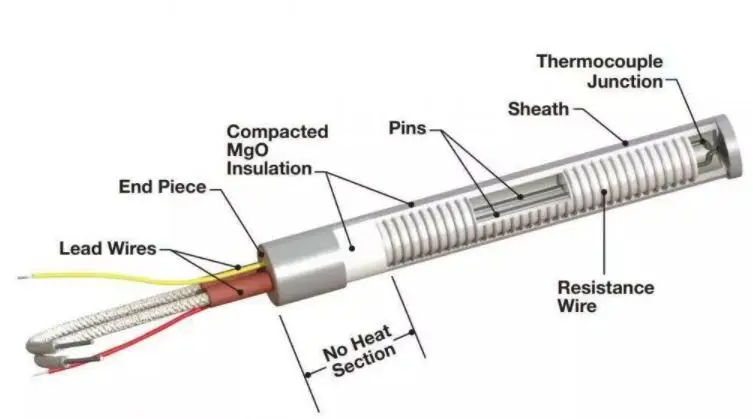
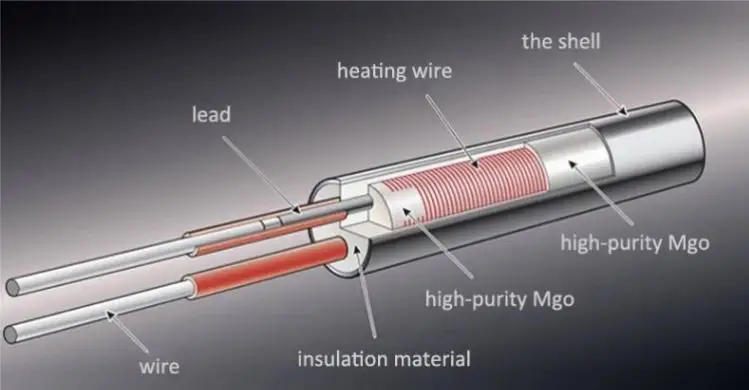
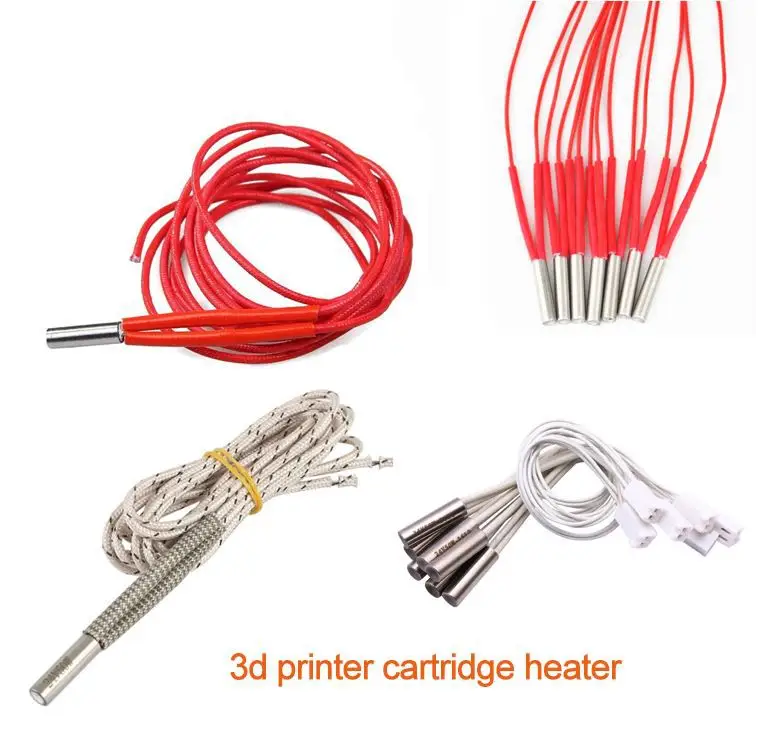
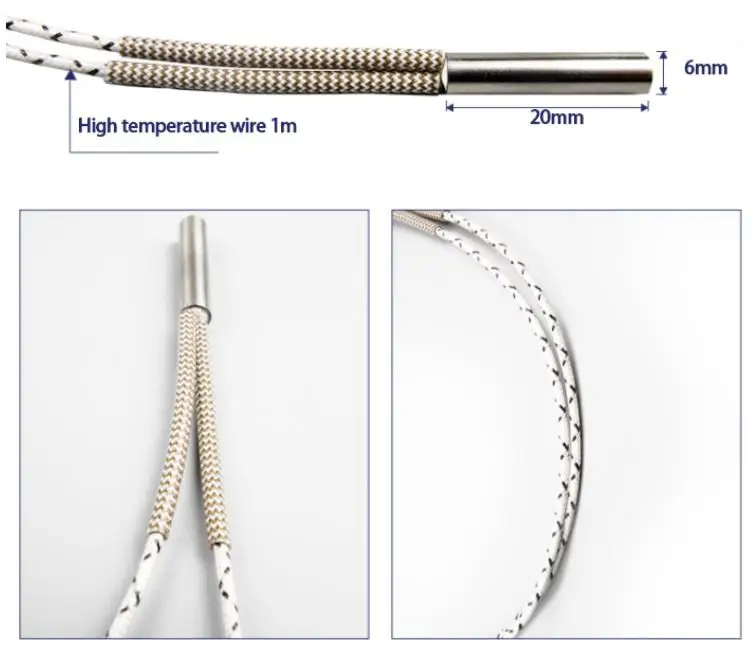
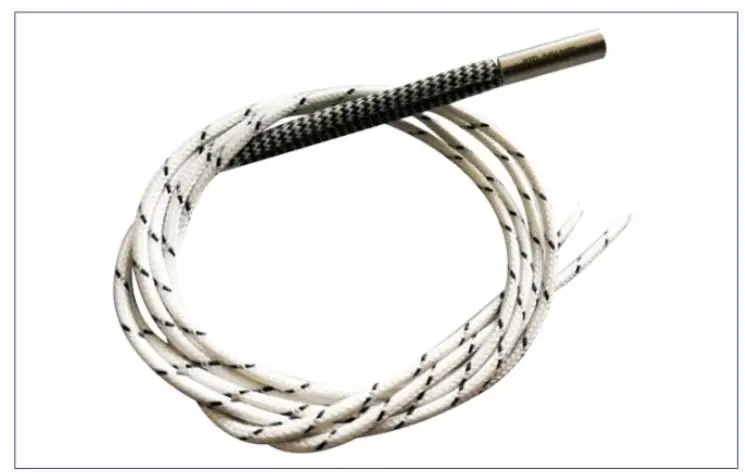
Products Advantages
High quality 304 stainless steel, Probe length 20mm
Wire material: AWG26 silicone cable and Glass fiber wire
Molex connector
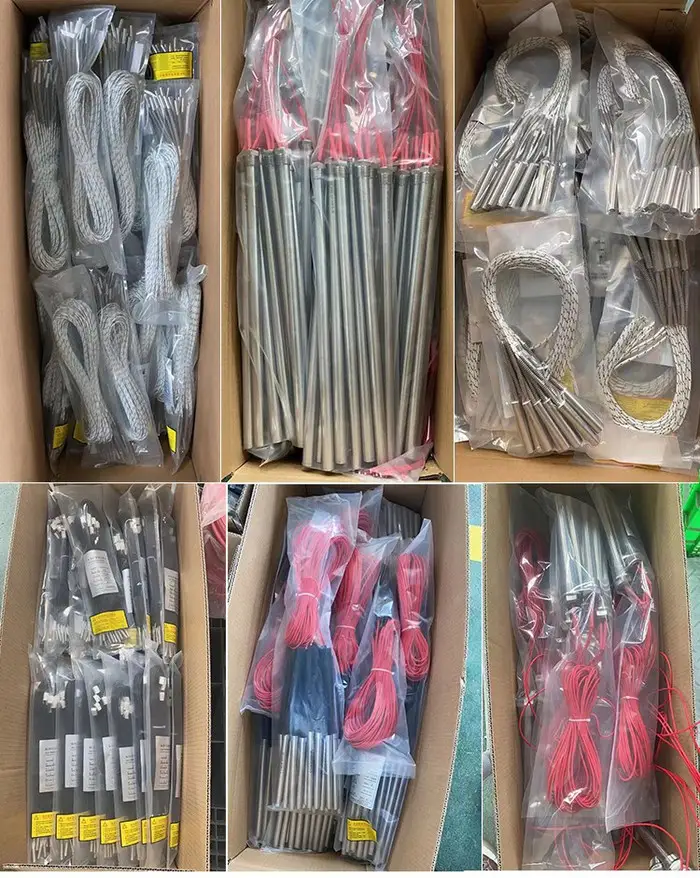
Package
The hotend of a 3D printer typically consists of a heating block, a temperature sensor (thermistor or thermocouple), and the cartridge heater. The filament is guided through the hotend, where the cartridge heater heats the nozzle to melt the material, allowing it to be precisely extruded layer by layer to create the 3D printed object.
It's important to use compatible and high-quality cartridge heaters in 3D printers to ensure stable and consistent printing results. Different 3D printers may require specific cartridge heater specifications, so it's essential to refer to the printer's manufacturer or documentation for the appropriate replacement cartridge heater or hotend maintenance.
You may contact any one of our sales and services team: email to us as inquiry.
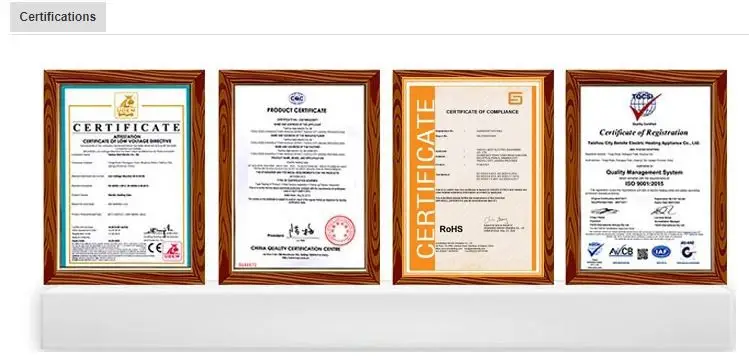
1. Qucik Response:Your inquiry will be replied within 24 hours. Response Rate over 90%
2. Smooth Communication: Well-trained and experienced staffs to answer all your inquires.
3. Sincere Service Attitude: Treat Customers As Friends. No Questions are Neglected.
4. OEM Accepted: Free Sample,We can customize your products to meet all your different requests.
5. Small MOQ: Small Amount wholesales are supported to meet your needs as well as large demands.
6. Fast Delivery: We have Reliable Forwarders with long term cooperation and Competitive Price.
Hot Tags: 3d printer heater 12v 40w, China, manufacturers, suppliers, factory, wholesale, customized, cheap, in stock, free sample, 230v electric cartridge heater, 80w 3d printer cartridge heater element, industrial electric cartridge heater heater, 230v electric cartridge heater supplier, heating element electric cartridge heater, stainless steel heater element cartridge
Specifications and availability vary by configuration. Confirm dimensions, materials and electrical or measurement ratings in your quotation.
ENGINEER-REVIEWED QUOTATION